Are Older Crop Varieties Costing Saskatchewan Farmers $344 Million?

By Trent Klarenbach, BSA AgEc, PAg, founder and lead analyst, Klarenbach Research. Nov. 16, 2026
The $344 million estimate
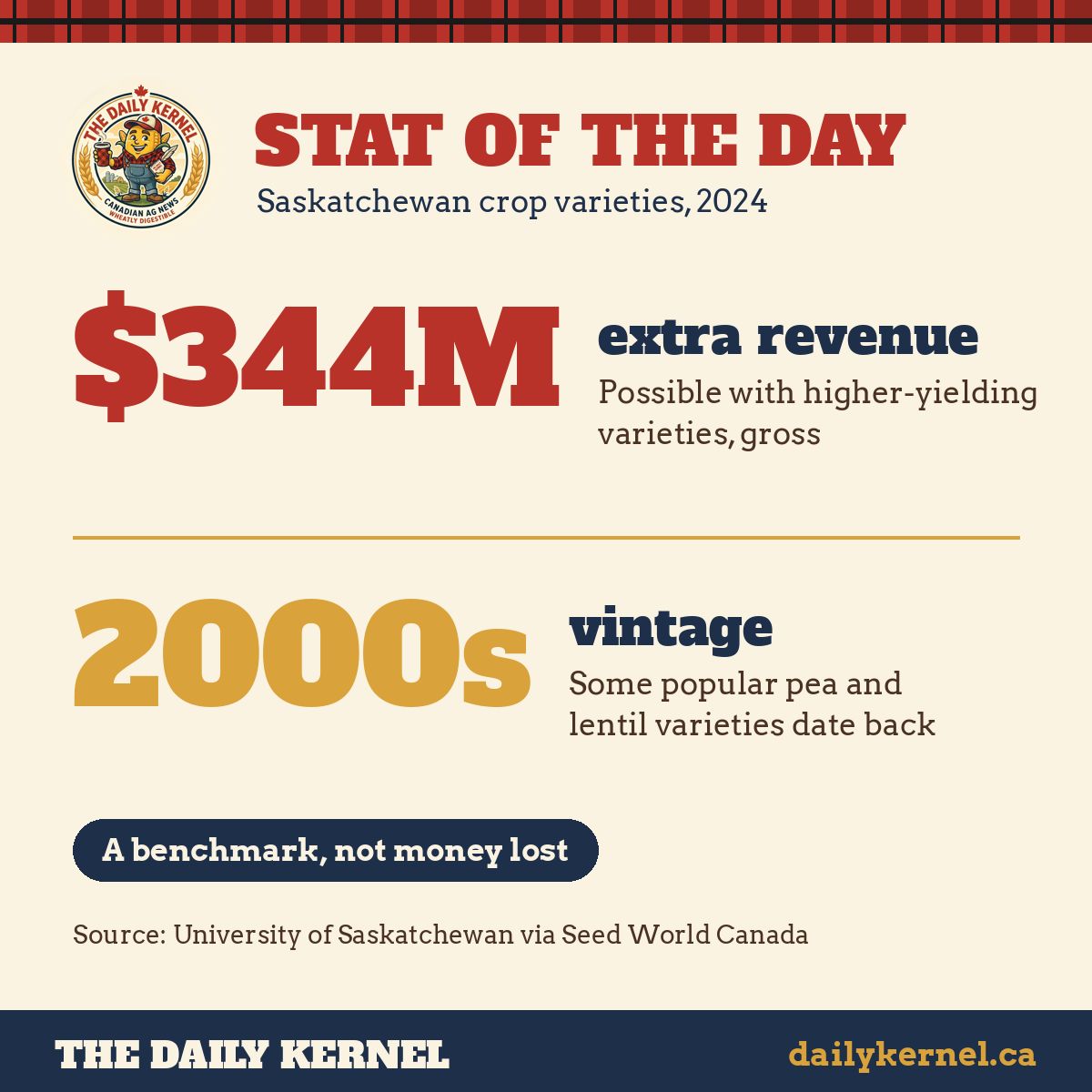
Agricultural economists Nicholas Tyack, Anissa Collishaw, Kim Sanderson and Vitaliia Mishchenko compared the varieties Saskatchewan farmers actually grew in 2024 with the highest-yielding varieties recorded in the same crop insurance risk zones. Their research note, covered by Seed World Canada on Nov. 12, puts the potential extra gross revenue at about $344 million.
By crop, that is roughly $176 million for spring wheat, $110 million for durum, $30 million for yellow peas and $28 million for red lentils.
Old favourites still dominate
Some of the province's most popular pea and lentil varieties date back to the 2000s. CDC Maxim, the top red lentil variety in the 2024 data, was released in 2007, as reported by The Western Producer. Farms growing established varieties such as AAC Brandon, CDC Maxim and CDC Meadow faced estimated average revenue gaps of $31 to $62 an acre against the top performers in their regions.
A benchmark, not money lost
The researchers are careful here. They assumed genetics explain half of the observed yield gap, with soil, management and weather explaining the rest. At 25%, the estimate is still about $172 million. The work does not fully account for harvestability, lodging, yield stability or whether the top-yielding variety suits every farm.
There are good reasons to stick with a variety that has performed on your own land. A variety that wins in one risk zone may lag in the next, and some zones have no variety trial sites at all.
Yield isn't the only trait
This fall made that point. Saskatchewan's final 2026 Crop Report had only 25% of durum grading No. 1 CW against a 39% average after a wet, late finish. Disease resistance, standability and sprouting tolerance can matter as much as bushels.
What to watch
- Follow-up research with Richard Gray surveying wheat producers and seed growers on what holds back variety trials
- More regional, multi-year variety trial data after registration
- Whether newer pulse varieties gain acres in 2027
The Grain Report covers these crops on its hard red spring wheat page and amber durum page.
Klarenbach Research is independent, takes no commissions and does not tell readers what percentage of their crop to sell.
Sources: Sanderson, Tyack, Mishchenko and Collishaw, Research Note: Economic Costs of Slow Varietal Adoption in Saskatchewan · Seed World Canada, Nov. 12, 2026 · The Western Producer · Government of Saskatchewan, Crop Report released Nov. 5, 2026
Originally posted on X: Trent Klarenbach's post on the $344 million variety gap