How Did Saskatchewan's 2026 Harvest Finish?

By Trent Klarenbach, BSA AgEc, PAg, founder and lead analyst, Klarenbach Research. Nov. 9, 2026
Harvest is done
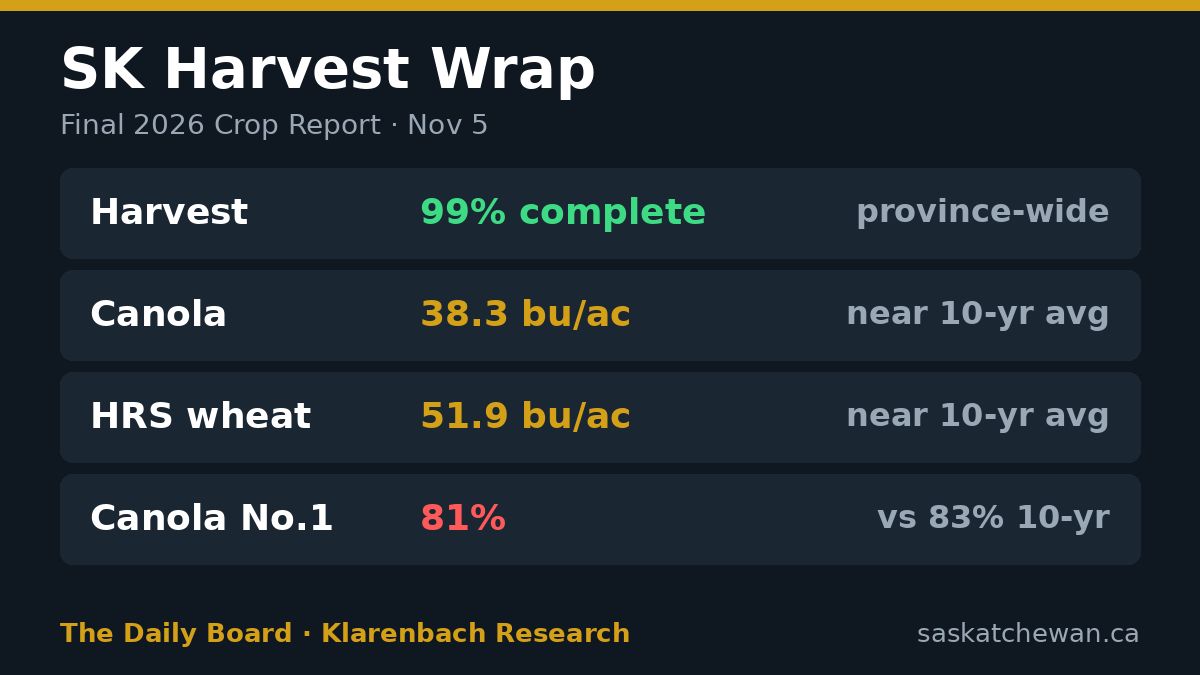
Saskatchewan's final Crop Report of the 2026 season, released Nov. 5, put harvest at 99% complete province-wide. Only a few acres of late-seeded flax (93%) and canary seed (97%) were still out.
Yields landed near average
Despite a messy year, the province says yields were mostly in line with 10-year averages. Canola came in at 38.3 bushels per acre and hard red spring wheat at 51.9. Durum was 44.2, barley 71.2, oats 96.7 and field peas 37.1. Lentils were estimated at 1,444.7 pounds per acre.
That is a decent result for a season where some fields were flooded in spring and seeded as late as June.
Quality is where it hurt
Rain kept falling late into the fall, and frost and humidity added to the problem. Lodging, bleaching and sprouting were all reported. Canola held up reasonably well, with 81% grading No. 1 Canada against an 83% 10-year average.
Durum took the bigger hit. Only 25% graded No. 1 CW, against a 39% average, and 16% fell into the lower "other" grades. Barley was similar: 16% graded malt, about half the 31% average. Lentils (25% No. 1 versus 31%) and peas (39% versus 42%) also slipped.
Why it matters
A near-average crop with more lower grades means more grain chasing feed and lower-grade markets, and wider price gaps between top and lower grades. Durum and malt barley growers are the most exposed.
Set-up for next year
Topsoil moisture on cropland is 83% adequate and 5% surplus heading into winter, a better start than many recent falls. Winter wheat acres fell 3% and fall rye 2%. Crop Insurance customers have until Nov. 15 to register post-harvest claims, including quality losses.
What to watch
- Statistics Canada's December production estimates
- Grade spreads for durum and feed versus malt barley
- Post-harvest claim volumes through SCIC
The Grain Report covers wheat on its Grain Report hard red spring wheat page and canola on its Grain Report canola page.
Klarenbach Research is independent, takes no commissions and does not tell readers what percentage of their crop to sell.
Sources: Government of Saskatchewan, Crop Report for the period Oct. 20 to Oct. 26, 2026, released Nov. 5, 2026
Originally posted on X: Trent Klarenbach's post on Saskatchewan's final 2026 Crop Report